

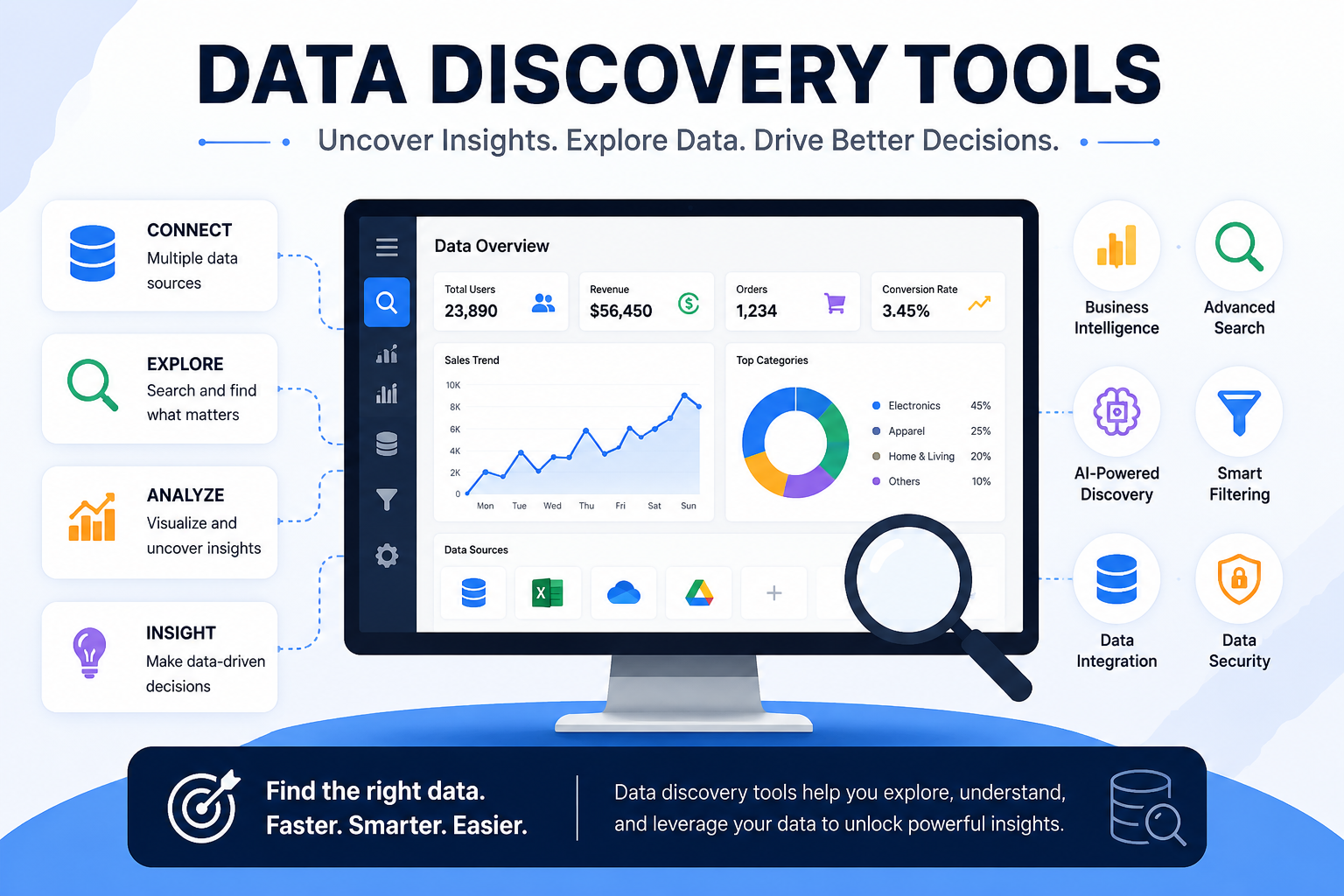
Data has become one of the most valuable assets for organizations of every size. Businesses collect information from customer interactions, sales systems, websites, mobile applications, cloud platforms, Internet of Things (IoT) devices, financial software, marketing campaigns, and countless other digital sources. While organizations have access to more data than ever before, finding the right information quickly and turning it into meaningful insights remains a significant challenge. This is where data discovery tools play a vital role.
Data discovery tools help organizations locate, organize, analyze, classify, and visualize data across multiple systems. They enable business users, analysts, data engineers, compliance teams, and executives to uncover valuable information without spending excessive time searching through disconnected databases and files. Modern data discovery platforms combine artificial intelligence, machine learning, metadata management, automated data cataloging, and advanced search capabilities to make enterprise data more accessible, trustworthy, and actionable. As organizations continue adopting cloud computing, hybrid environments, and AI-driven analytics, data discovery has become an essential part of successful data management and business intelligence strategies.What Are Data Discovery Tools?
Data discovery tools are software platforms designed to help organizations identify, access, understand, and analyze data stored across multiple systems. Rather than requiring users to know exactly where information resides, these platforms automatically scan databases, cloud storage, data warehouses, business applications, spreadsheets, APIs, and other repositories to create searchable catalogs. Users can then quickly locate relevant datasets, understand their structure, review metadata, and determine whether the information is suitable for reporting, analytics, compliance, or operational decision-making.
Modern data discovery platforms extend well beyond simple search capabilities. They automatically profile datasets, identify relationships between data sources, classify sensitive information, detect duplicates, and provide data lineage that shows how information moves throughout an organization. Many solutions also integrate with business intelligence platforms, data governance frameworks, and analytics tools, allowing organizations to maintain consistent, reliable, and secure access to enterprise data while reducing manual data management efforts.
Why Data Discovery Tools Are Essential for Modern Businesses
Organizations generate enormous volumes of structured and unstructured data every day. Without an effective discovery solution, valuable information often becomes scattered across departmental systems, cloud services, file servers, and legacy databases. Employees spend significant time searching for trustworthy data, verifying accuracy, and determining whether datasets remain current. Data discovery tools reduce this inefficiency by creating centralized visibility into enterprise information assets and making them easier to locate and understand.
Beyond operational efficiency, data discovery strengthens decision-making across every level of an organization. Business leaders can access accurate reports more quickly, analysts can identify trends with greater confidence, and compliance teams can locate regulated information required for audits or privacy requests. As digital transformation initiatives accelerate and organizations increasingly rely on data-driven strategies, discovery platforms become critical infrastructure supporting analytics, artificial intelligence, governance, cybersecurity, and regulatory compliance.
Key Features of Modern Data Discovery Tools
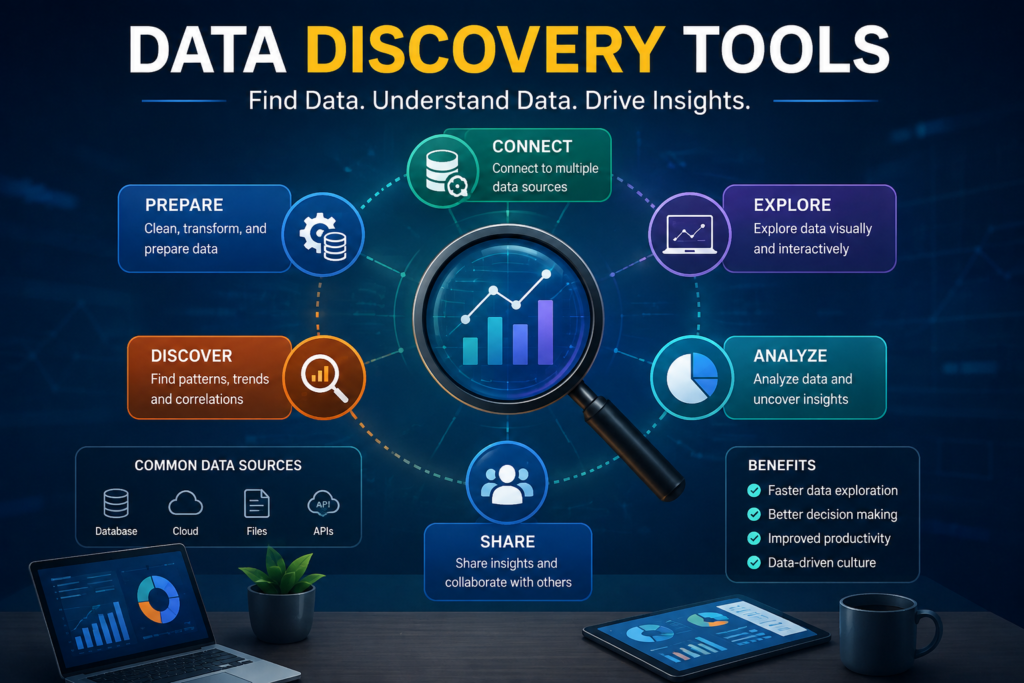
Today’s data discovery tools offer a broad range of capabilities that extend far beyond traditional data search. Automated data cataloging remains one of the most valuable features because it continuously scans enterprise systems and updates metadata as new information becomes available. Intelligent search functions allow users to locate datasets using business terms rather than technical database names, making data more accessible to non-technical employees. Metadata management further improves understanding by documenting ownership, quality, definitions, classifications, and usage history. data discovery tools.
Artificial intelligence and machine learning have significantly enhanced modern discovery platforms. AI-powered algorithms automatically classify sensitive information, recommend relevant datasets, detect anomalies, and identify relationships between previously disconnected data sources. Data lineage tracking enables organizations to understand how information flows from its original source through various transformations before reaching reports or dashboards. These capabilities increase transparency while supporting data quality initiatives and improving confidence in analytical outcomes.
How Data Discovery Supports Data Governance and Compliance
Data governance has become increasingly important as organizations face stricter privacy regulations and growing cybersecurity risks. Data discovery tools support governance by identifying where sensitive information resides, who has access to it, and how it moves throughout enterprise systems. Automated classification helps organizations distinguish personally identifiable information, financial records, healthcare data, intellectual property, and other sensitive assets that require additional protection or regulatory oversight.
Compliance initiatives benefit significantly from comprehensive data discovery because organizations can respond more efficiently to regulatory requirements involving data privacy, retention, auditing, and access controls. Discovery platforms simplify compliance with regulations such as GDPR, CCPA, HIPAA, and other regional privacy frameworks by providing greater visibility into enterprise data inventories. Accurate metadata, detailed audit trails, and automated policy enforcement help reduce compliance risks while strengthening overall data governance practices across the organization.
Data Discovery and Business Intelligence
Business intelligence depends on accurate, accessible, and trustworthy data. Data discovery tools enhance business intelligence by ensuring analysts can quickly identify reliable datasets before creating dashboards, reports, or predictive models. Instead of manually gathering information from multiple systems, users gain immediate access to curated data catalogs that reduce duplication and improve reporting consistency across departments.
Self-service analytics has become one of the most important developments in modern business intelligence, and data discovery platforms play a central role in enabling this capability. Marketing professionals, finance teams, operations managers, and executives can independently locate relevant data without relying exclusively on IT departments. This increased accessibility accelerates reporting cycles, supports faster decision-making, and encourages broader adoption of data-driven practices throughout the organization while maintaining appropriate governance controls.
Industries That Benefit from Data Discovery Tools
Virtually every industry benefits from implementing data discovery tools because all organizations rely on accurate information to support operations and strategic planning. Financial institutions use discovery platforms to manage regulatory compliance, detect fraud, improve customer insights, and monitor risk across complex data environments. Healthcare organizations rely on data discovery to locate patient records, protect sensitive medical information, support clinical research, and maintain compliance with healthcare privacy regulations. data discovery tools.
Retailers use discovery tools to analyze customer behavior, inventory performance, supply chain operations, and marketing effectiveness. Manufacturing companies improve production efficiency by discovering operational data from equipment sensors, quality systems, and maintenance records. Government agencies, educational institutions, telecommunications providers, insurance companies, logistics organizations, and technology firms similarly depend on enterprise data discovery to improve operational visibility, optimize resource allocation, strengthen cybersecurity, and support informed decision-making across increasingly complex digital ecosystems.
Choosing the Right Data Discovery Tool
Selecting an appropriate data discovery solution requires careful evaluation of organizational requirements, existing technology infrastructure, and long-term business objectives. Scalability is particularly important because enterprise data volumes continue growing rapidly as organizations adopt additional cloud services, connected devices, and digital business applications. The chosen platform should integrate seamlessly with databases, cloud environments, data lakes, analytics platforms, and business intelligence tools while supporting both structured and unstructured data sources. data discovery tools.
Ease of use is another critical consideration. Effective discovery platforms provide intuitive search capabilities, customizable dashboards, clear metadata visualization, and collaboration features that enable technical and non-technical users to work efficiently. Security capabilities, access controls, role-based permissions, API integration, automation, artificial intelligence support, vendor reliability, implementation services, and ongoing customer support also influence long-term success. Organizations should prioritize solutions that align with their governance strategies while remaining flexible enough to accommodate future technology adoption and business growth.
Future Trends in Data Discovery Technology
The future of data discovery is increasingly shaped by artificial intelligence, automation, and cloud-native architectures. AI-driven metadata generation continues reducing manual administrative tasks while improving classification accuracy and search relevance. Natural language search capabilities allow users to locate information using conversational business terminology rather than technical database queries, making enterprise data more accessible to a wider audience. Intelligent recommendation engines further simplify analytics by suggesting related datasets, commonly used reports, and potential business insights.
Cloud computing, hybrid infrastructure, and multi-cloud environments are also driving innovation in data discovery platforms. Organizations require unified visibility across distributed data ecosystems that span on-premises systems, public cloud providers, private clouds, SaaS applications, and edge computing environments. Emerging technologies such as generative AI, semantic search, knowledge graphs, automated data observability, and predictive governance will continue transforming how businesses discover, understand, and utilize information. These advancements promise greater efficiency, stronger compliance, and faster access to trusted data for organizations operating in increasingly complex digital environments.
Best Practices for Maximizing the Value of Data Discovery Tools
Implementing a data discovery platform is only the first step toward building a successful data-driven organization. Long-term success depends on maintaining accurate metadata, regularly updating data catalogs, establishing clear governance policies, and encouraging collaboration between business users, data engineers, security teams, and executive leadership. Consistent documentation of data definitions, ownership, quality metrics, and usage guidelines improves trust while reducing confusion across departments.
Organizations should also invest in user education to ensure employees understand how to locate, interpret, and responsibly use enterprise data. Regular audits, continuous monitoring, automated quality checks, and governance reviews help maintain reliable discovery environments as new systems and datasets are introduced. By integrating data discovery into broader business intelligence, cybersecurity, analytics, and digital transformation strategies, organizations maximize the return on their technology investments while creating a culture that values accurate, secure
Conclusion
Data discovery tools have become indispensable for organizations seeking to unlock the full value of their information assets. By automatically locating, cataloging, classifying, and organizing enterprise data, these platforms eliminate many of the challenges associated with fragmented information systems, manual searches, and inconsistent reporting. Their integration with artifiata management, data governance, and business intelligence solutions enables organizations to improve operational efficiency, strengthen regulatory compliance, enhance cybersecurity, and support faster, more confident decision-making.
As businesses continue generating larger volumes of structured and unstructured data across cloud platforms, hybrid environments, and connected technologies, the importance of comprehensive data discovery will only continue growing. Organizations that invest in reliable data discovery tools while establishing strong governance practices and promoting responsible data usage position themselves for long-term success in an increasingly data-driven economy. With trusted access to accurate information, businesses can make smarter strategic decisions, improve customer experiences, drive innovation, and maintain a competitive advantage in an evolving digital landscape.
