

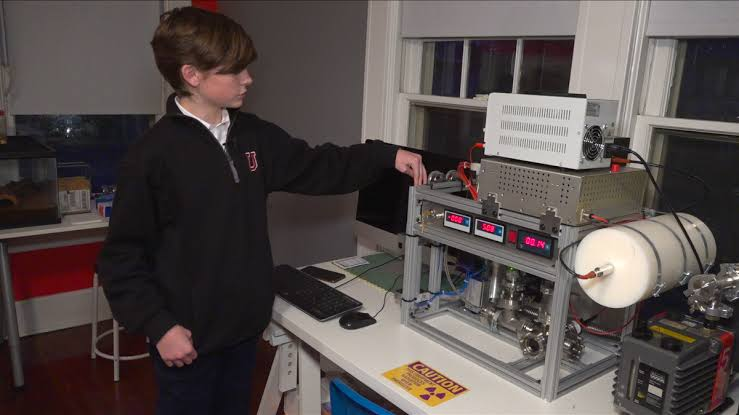
Jackson Oswalt is widely recognized for achieving one of the most remarkable science-related accomplishments by a teenager in recent years. He gained international attention after successfully building a small experimental nuclear fusion device at home and becoming one of the youngest people ever to accomplish a verified fusion reaction. His story quickly spread across scientific communities, news organizations, and social media, inspiring students, educators, and technology enthusiasts around the world.
Although Jackson Oswalt‘s achievement is often summarized as “building a nuclear reactor,” that description is misleading. In reality, he constructed an experimental inertial electrostatic confinement fusion device, commonly known as a fusor. A fusor is designed to create nuclear fusion under controlled laboratory conditions, but it does not generate usable electricity like commercial nuclear power plants. Understanding this distinction is essential when learning about Oswalt’s accomplishment and its significance in science education and amateur research.
Who Is Jackson Oswalt?
Jackson Oswalt is an American technology enthusiast, programmer, and science advocate who became famous after achieving verified nuclear fusion as a teenager. Motivated by curiosity and a passion for physics, he began studying nuclear science independently, using publicly available educational resources, technical papers, and guidance shared by experienced members of the amateur fusion community. His determination to understand complex scientific principles at a young age earned widespread recognition. jackson oswalt
Oswalt’s work attracted international media attention because it demonstrated how self-directed learning, combined with responsible scientific guidance, can lead to extraordinary achievements. Beyond his early accomplishment, he has continued to express strong interests in software development, engineering, computer programming, and emerging technologies. His journey reflects the growing influence of online educational resources in helping motivated learners explore advanced scientific subjects.
Understanding the Fusion Experiment
The experiment that brought Jackson Oswalt global attention involved constructing a fusor, a device capable of producing small-scale nuclear fusion reactions. A fusor works by creating a high-voltage electric field inside a vacuum chamber that accelerates deuterium ions toward one another. When enough ions collide with sufficient energy, a small number of nuclear fusion reactions occur, releasing detectable neutrons. jackson oswalt
It is important to understand that achieving fusion in a fusor differs significantly from creating a practical fusion power plant. While the device successfully demonstrates nuclear fusion, it consumes more energy than it produces and is intended primarily for research and educational purposes. Scientists and engineers have used similar devices for decades to study plasma physics, neutron generation, and nuclear science rather than electricity production.
Verification of His Achievement
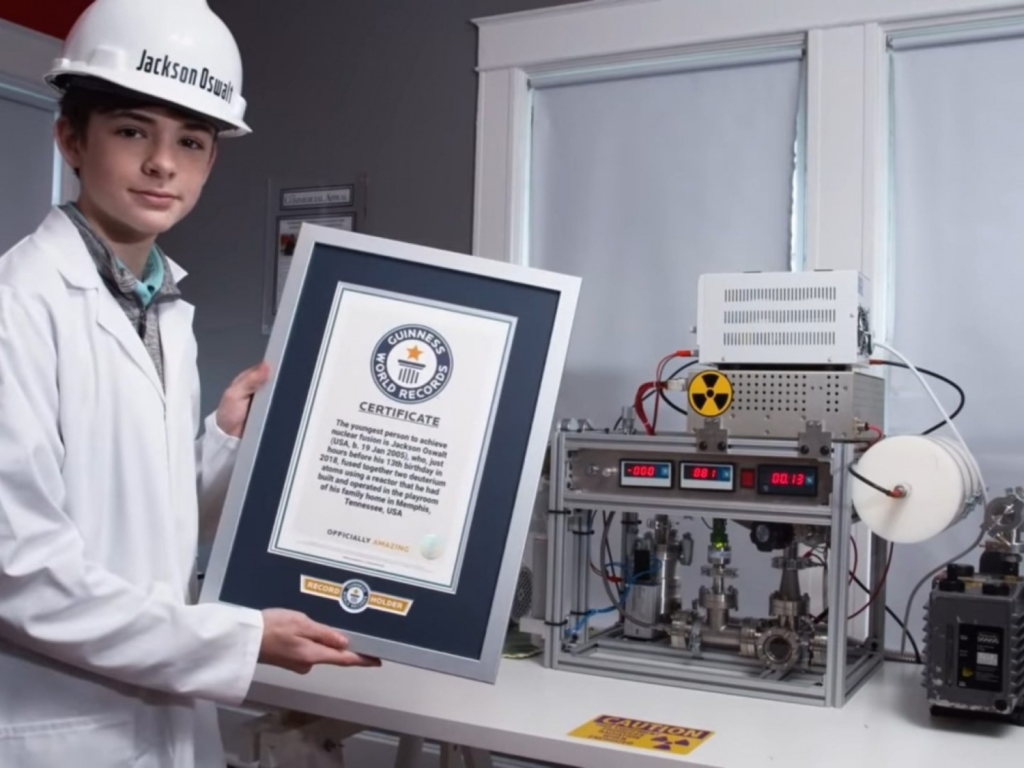
One reason Jackson Oswalt’s accomplishment received considerable attention is that it was independently verified rather than simply claimed online. Members of the amateur fusion community confirmed that his device had produced measurable neutron emissions consistent with genuine fusion reactions. This verification distinguished his work from many internet claims that lack scientific evidence or independent confirmation.
His achievement also gained recognition from organizations that document notable scientific milestones. Reports describing his successful fusion experiment highlighted both his age and the technical complexity of the project. Although records related to the “youngest person to achieve fusion” may evolve over time as new verified accomplishments emerge, Oswalt remains one of the most recognized young individuals associated with amateur nuclear fusion research.
The Science Behind Nuclear Fusion
Nuclear fusion is the process through which two light atomic nuclei combine to form a heavier nucleus while releasing energy. This is the same fundamental process that powers the Sun and other stars. Scientists have spent decades researching controlled fusion because it has the potential to provide abundant, low-carbon energy if practical commercial fusion reactors can eventually be developed.
Fusion differs from nuclear fission, which powers today’s conventional nuclear power plants. Fission splits heavy atomic nuclei into smaller ones, while fusion combines lighter nuclei. Achieving controlled fusion on Earth requires extremely challenging conditions involving very high temperatures, strong magnetic confinement, or specialized experimental systems. Oswalt’s fusor demonstrated fusion on a small experimental scale but did not solve the engineering challenges associated with commercial fusion energy.
Learning Through Independent Research
One of the most inspiring aspects of Jackson Oswalt’s story is his commitment to independent learning. Rather than relying solely on traditional classroom instruction, he studied advanced scientific concepts through technical literature, educational videos, online forums, and discussions within the amateur fusion community. This combination of curiosity and persistence enabled him to understand subjects that many students encounter only at the university level.
His experience illustrates the growing accessibility of high-quality educational resources available through the internet. Open-access research papers, engineering communities, scientific lectures, and educational platforms now provide motivated learners with opportunities to study advanced topics independently. However, Oswalt has also emphasized that complex scientific experiments require careful planning, appropriate supervision, and strict attention to safety.
Safety and Responsible Scientific Exploration
Although Jackson Oswalt’s achievement has inspired many young science enthusiasts, it should never be interpreted as encouragement to attempt similar experiments without appropriate expertise and supervision. Fusion research involves hazardous high-voltage electrical systems, vacuum technology, compressed gases, radiation detection equipment, and potential neutron radiation. These risks require specialized knowledge, professional safety procedures, and suitable laboratory environments.
Responsible scientific exploration always places safety above experimentation. Professional researchers, universities, and qualified laboratories follow strict regulations governing radiation protection, electrical safety, equipment design, and experimental procedures. Students interested in nuclear physics can safely develop their knowledge through classroom education, laboratory demonstrations, simulation software, robotics, programming, mathematics, and supervised science projects before considering more advanced research opportunities.
Influence on STEM Education and Innovation
Jackson Oswalt’s story has encouraged renewed interest in STEM education, particularly among students fascinated by physics, engineering, computer science, and scientific research. Teachers frequently reference his achievement when discussing curiosity-driven learning, scientific perseverance, and the importance of understanding fundamental scientific principles. His accomplishment demonstrates that age alone does not determine a person’s ability to contribute meaningfully to technical fields.
Beyond nuclear fusion, Oswalt has become associated with broader themes of innovation, entrepreneurship, and technological creativity. Many young learners view his journey as evidence that ambitious goals become more attainable through disciplined study, experimentation, and continuous learning. His example reinforces the value of critical thinking, problem-solving, and lifelong education in preparing future generations of scientists and engineers.
Jackson Oswalt’s Continuing Career
Following his widely publicized fusion achievement, Jackson Oswalt has continued pursuing interests in software engineering, programming, and advanced technology. Like many talented young innovators, he has expanded his focus beyond a single scientific milestone while remaining engaged with engineering and technical communities. His broader interests demonstrate the interdisciplinary nature of modern innovation, where skills in software, electronics, mathematics, and engineering often complement one another.
His continued involvement in technology reflects a common path among scientifically curious individuals who begin exploring one specialized subject before expanding into multiple disciplines. Whether working with programming, artificial intelligence, hardware development, or engineering research, Oswalt represents a generation of learners who combine self-education with practical experimentation to develop valuable technical expertise.
Conclusion
Jackson Oswalt‘s remarkable journey from curious teenager to internationally recognized science enthusiast highlights the extraordinary potential of independent learning, persistence, and responsible scientific exploration. His verified achievement in producing nuclear fusion within a small experimental fusor captured worldwide attention while inspiring countless students to develop deeper interests in physics, engineering, mathematics, and technology. Although his experiment did not produce commercial fusion energy, it demonstrated genuine scientific understanding and technical skill far beyond what many would expect from someone so young.
As research into nuclear fusion continues around the world, Jackson Oswalt’s story serves as a reminder that curiosity remains one of the strongest drivers of innovation. His accomplishments emphasize the importance of scientific integrity, careful verification, continuous education, and responsible experimentation. For aspiring scientists, engineers, and technology enthusiasts, his experience illustrates that remarkable achievements begin with asking questions, seeking knowledge, and approaching every challenge with dedication, patience, and respect for both science and safety.
